
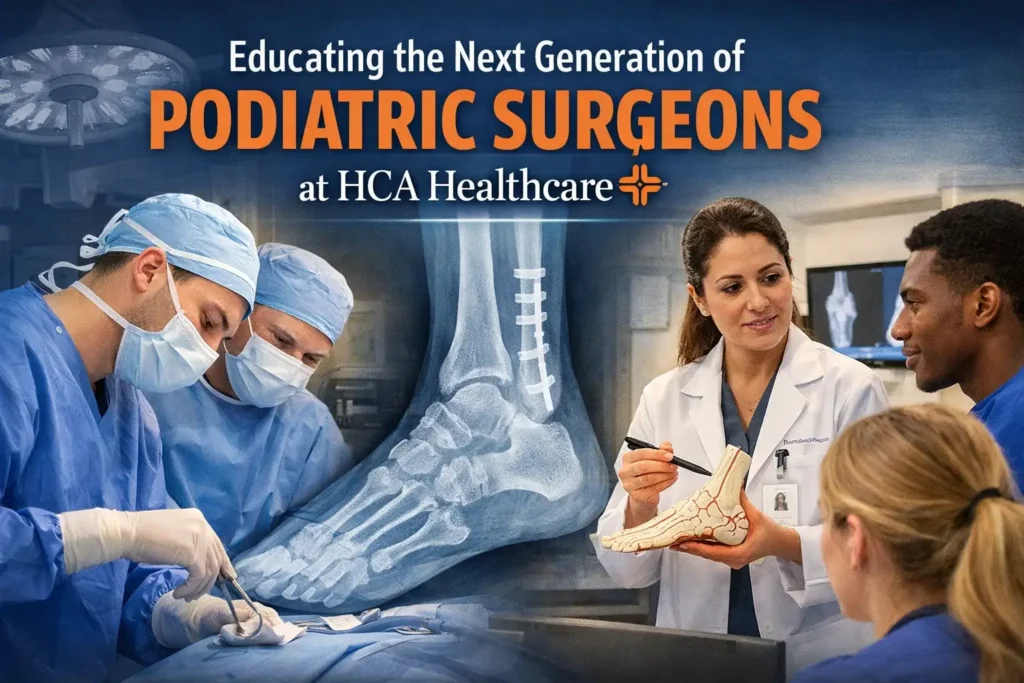
On February 21, 2026, a room full of podiatric residents and fellows at HCA Healthcare in Fort Lauderdale became part of a much larger classroom. What began as a focused educational session quickly became a nationwide learning experience as the lecture was broadcast to HCA Healthcare facilities and shared with leading podiatric organizations across the United States.
Leading the session were Dr. Bhavesh Shah and Dr. Benard, both respected members of the education committee of Complex Foot and Ankle Reconstruction and co-directors of Operation Footprint, an initiative committed to advancing reconstructive foot and ankle care. The two doctors guided young surgeons through the complex science and discussion of foot and ankle deformity correction, supported by years of surgical expertise and academic leadership.
The lectures centered on residents and fellows training in podiatric medicine and surgery. However, its impact extended far beyond the walls of the Fort Lauderdale facility. Physicians and trainees connected through HCA Healthcare, Complex Foot and Ankle Reconstruction membership, the American College of Podiatric Medicine, and the American Academy of Podiatric Sports Medicine joined the session to gain insight into modern reconstructive techniques.
Through this nationally shared educational platform, Dr. Shah and Dr. Benard introduced contemporary approaches to the correction of foot and ankle deformities while exploring the surgical strategies shaping the future of reconstructive care.
Progressive Concepts in Foot and Ankle Deformity Correction
Dr. Shah and Dr. Benard presented key clinical concepts related to deformity correction in both pediatric and adult patients. First, they examined traditional surgical philosophies that guide reconstructive foot and ankle care, followed by contemporary philosophies to inform decision-making. These approaches often reflect conflicting teaching methods and evolving clinical perspectives within the field.
In addition, the physicians introduced progressive concepts in deformity correction and compared current treatment strategies used by specialists worldwide. They explained how surgeons evaluate structural deformities, choose appropriate surgical interventions, and adapt techniques to improve outcomes.
The lecture explored both traditional procedures and emerging reconstructive techniques. These methods aim to improve patient recovery, enhance structural stability, and reduce long-term complications.
Consequently, residents and fellows gained a deeper understanding of how to critically evaluate treatment options. By studying multiple frameworks and clinical approaches, trainees learned how to tailor surgical strategies to each patient’s unique condition.
Mentorship and Surgical Excellence in Foot and Ankle Reconstruction
Dr. Bhavesh Shah also drew on his extensive experience treating both pediatric and adult deformities. Through practical insights, he mentored young physicians who are beginning their careers in reconstructive podiatric surgery.
He emphasized the perseverance, discipline, and consistency required to succeed in complex foot and ankle reconstruction. Rather than focusing only on surgical techniques, he encouraged physicians to develop strong clinical judgment and patient-centered treatment plans.
Additionally, he highlighted the importance of thoughtful surgical planning and long term care strategies. Complex reconstructive procedures require careful evaluation, precise execution, and a commitment to continued learning.
By sharing real clinical experiences, Dr. Shah demonstrated how experienced surgeons approach challenging deformity cases. These insights helped trainees understand how to balance surgical precision with patient safety and recovery goals.
The Role of Multidisciplinary Collaboration in Patient Outcomes
Another major focus of Dr. Shah’s lecture involved the role of multidisciplinary collaboration in treating complex deformities. Successful reconstructive outcomes rarely depend on a single specialist. Surgeons must work closely with orthopedic specialists, physical therapists, and rehabilitation experts to support full patient recovery.
For example, coordinated treatment plans allow healthcare teams to address structural correction, rehabilitation progress, and long term mobility. This collaborative approach helps patients regain function and maintain improved quality of life.
At the same time, Dr. Shah encouraged physicians to stay current with emerging research, surgical innovations, and evidence-based treatment strategies.
Therefore, continuous education and professional collaboration remain essential in advancing standards of care in foot and ankle reconstruction surgery.
Advancing Innovation in Foot and Ankle Reconstruction
Finally, Dr. Shah concluded the lecture by presenting detailed case studies that demonstrated both the challenges and successes of deformity correction procedures.
These real world examples helped residents and fellows connect surgical theory with clinical practice. As a result, trainees gained practical insight into how innovative techniques can improve patient outcomes. He encouraged young physicians to pursue evidence-based decision making while remaining open to new surgical advancements.
Ultimately, his message emphasized mentorship, collaboration, and lifelong learning within the podiatric medical community.
Through educational initiatives like this national lecture, Dr. Bhavesh Shah continues to shape the next generation of surgeons while advancing patient care in complex foot and ankle reconstruction.